
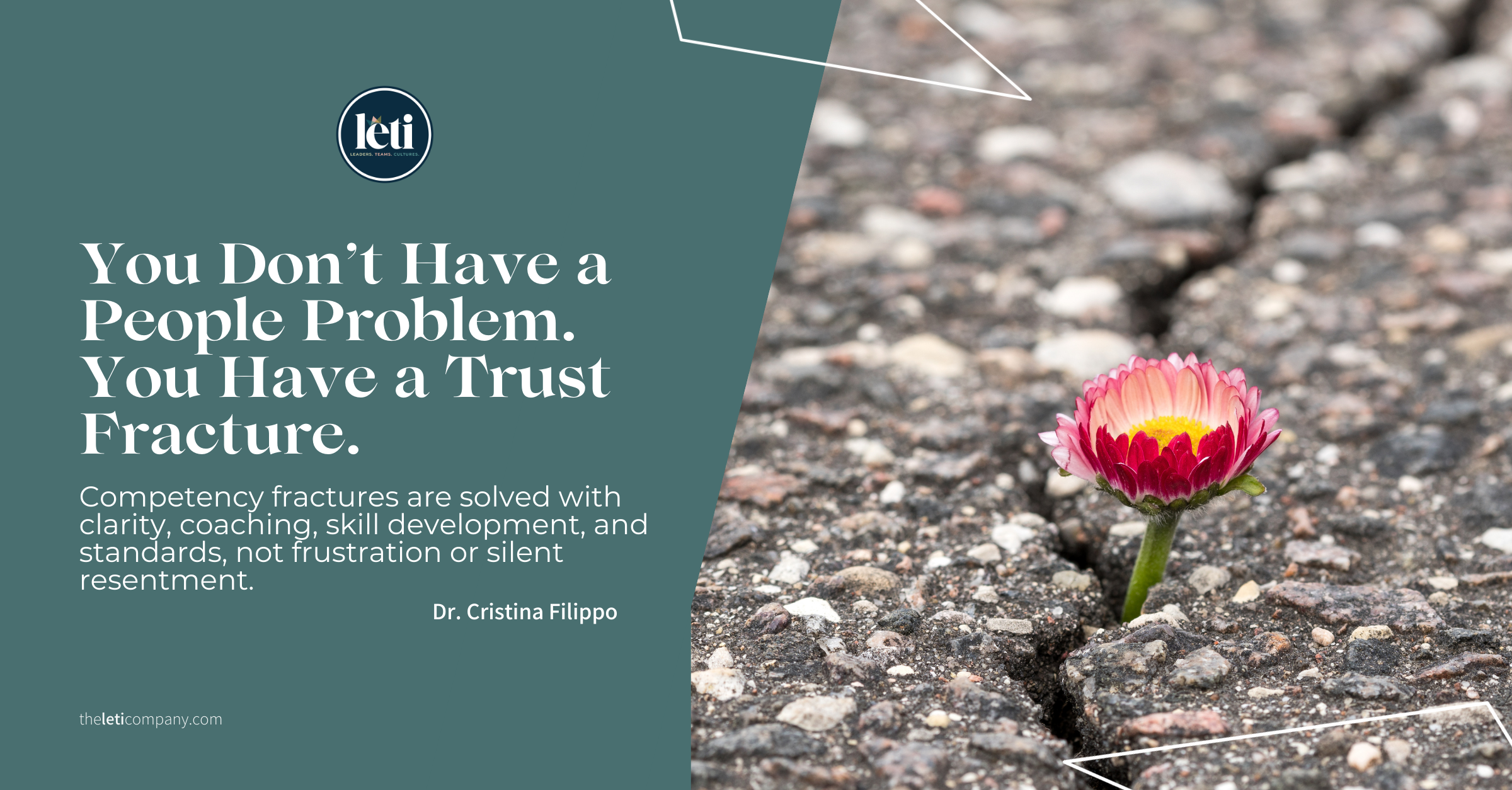
You Don’t Have a People Problem. You Have a Trust Fracture.
March 3, 2026
Leaders say it all the time: “I just don’t trust them.”
But trust isn’t a personality trait.
It’s the foundation everything else stands on.
And when something feels off on your team, you’re not dealing with “a difficult person.” You’re dealing with a fracture in one of four pillars of trust.
If you can’t name which pillar is cracked, you can’t fix it. In working with teams, these four pillars have been tried and and true for the us for years:
1. Competency Trust
Can you actually do the job?
This is the most visible fracture.
You assign a project. It comes back half-done. Deadlines slip. Details get missed. You start double-checking everything.
That’s not micromanagement. That’s your brain reacting.
Neuroscience shows the amygdala scans constantly for threat and uncertainty. When performance is inconsistent, your brain shifts into protection mode. You hover because predictability has disappeared.
Competency fractures are solved with clarity, coaching, skill development, and standards, not frustration or silent resentment.
2. Contractual Trust
Do you do what you say you will do?
This one is quieter…but deadly.
They say you’ll send the recap. They don’t. They promise to follow up. They forget. Deadlines move “just this once.” Again.
Every broken agreement is a micro-breach.
The brain builds trust through pattern recognition. Consistency wires safety. Inconsistency wires doubt. Over time, people stop relying on each other – not because they’re malicious, but because experience has trained them not to.
When contractual trust fractures, tighten agreements. Clarify ownership. Stop tolerating vague commitments.
3. Communication Trust
Are you telling me the truth? And are you for me, not against me?
This fracture shows up in meetings.
People nod but don’t speak. Concerns surface in side-bar conversations instead of the room. Feedback feels filtered or political.
Ambiguity increases cortisol. The brain reads unclear intent as risk. When people aren’t sure what’s real, they protect themselves.
Communication trust requires candor. Directness. Clean feedback. No triangulation.
Not harshness. Not avoidance. Clarity.
4. Caring Trust
Do you actually care about me and about the impact you have on others?
This is the deepest layer.
Do you respect different cultural norms around communication and authority? Do you pause to understand perspectives that don’t mirror your own? Do you consider how your decisions affect workloads, families, identities?
Social exclusion activates the same neural regions as physical pain. Belonging isn’t “nice to have.” It’s biological. When people feel unseen or culturally dismissed, they disengage long before they resign.
Caring trust isn’t about being warm. It’s about being aware.
Curiosity over assumption. Respect across difference. Making room for voices that don’t sound like yours.
Without caring trust, teams comply. They don’t commit.
Here’s what we know:
Trust fractures don’t announce themselves.
They show up as tension. As politics. As turnover. As “low engagement.” As leaders who feel exhausted from carrying everything themselves.
Most leaders misdiagnose the problem.
They blame attitude. They blame personality. They blame “culture.”
But high-performing teams don’t tolerate vague distrust.
They identify the fracture. They name the pillar. They repair it with behavioral shifts.
Raise the standard of competence. Honor commitments without exception. Tell the truth in the room. Demonstrate respect across difference.
Trust is not soft.
It is the foundation.
And when it fractures, performance collapses quietly…long before the metrics show it.
If something feels off on your team, don’t ask, “Why don’t I trust them?”
Ask: Where is the fracture?
If your team isn’t living up to its capabilities, message me and we can diagnose the issues that need to be repaired.
Cristina “I Notice Patterns” Filippo